The Skin
Baltic amber is older than the language we use to describe it.
40 million years, ten countries, one warming object. Why ancient resin behaves differently against the skin.
The Practice
The lymphatic system is the body's drainage network — a one-way circuit of vessels, nodes, and ducts that clears interstitial fluid, immune debris, and metabolic waste. Unlike the cardiovascular system, lymph has no central pump. It moves only when the body moves, when smooth muscle contracts, and when external pressure (breath, massage, brushing) drives it forward.
From Jess
I came to dry brushing the way most practitioners come to anything — sceptically. Then I watched it work, on myself first, then on clients. The mechanism is unglamorous. The result is not.
— Jess Mason
Baltic amber is older than the language we use to describe it.
40 million years, ten countries, one warming object. Why ancient resin behaves differently against the skin.
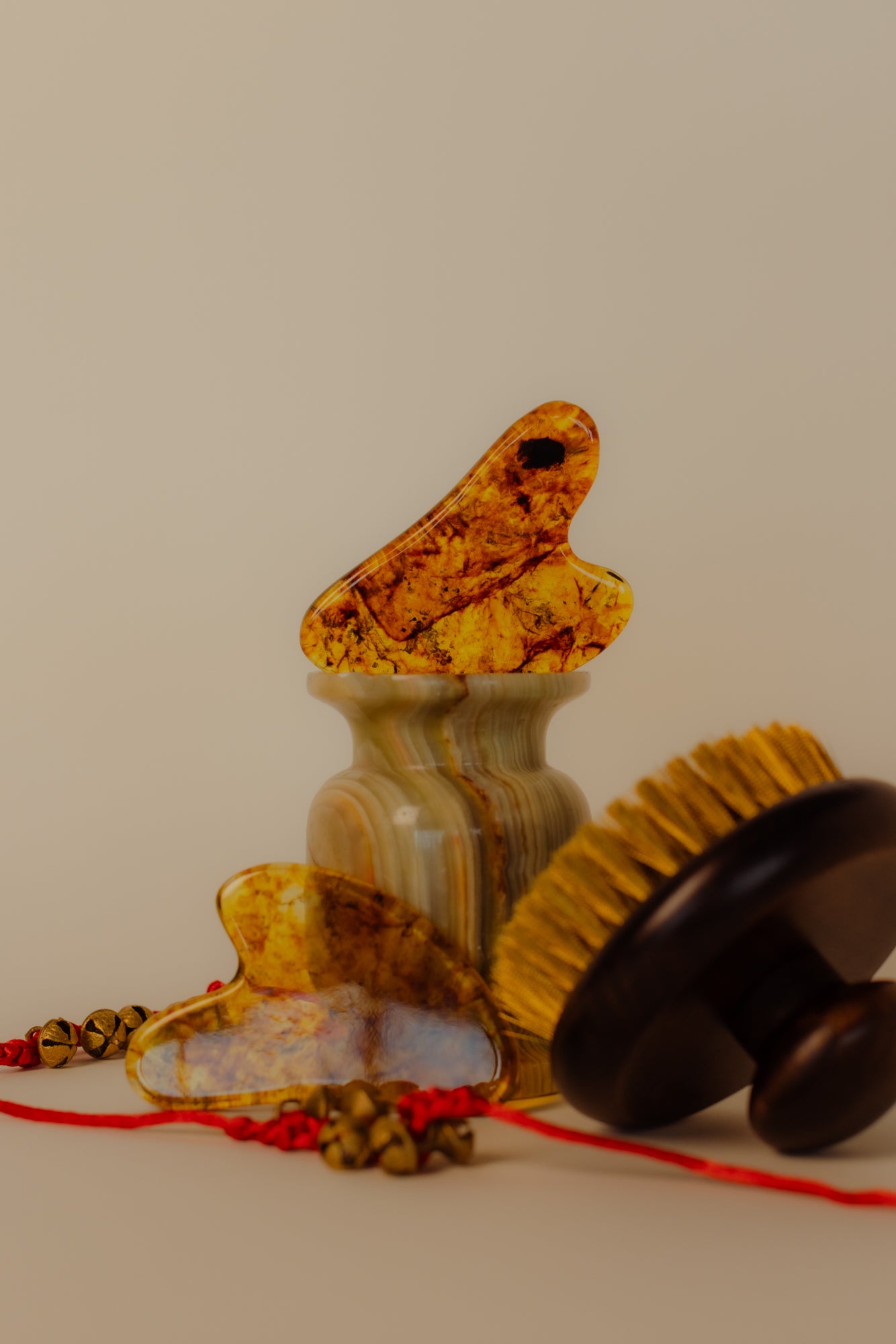
Amber isn't a stone. It isn't a crystal. It's resin — once flowing through living trees, then trapped in the earth, then rolled by oceans for tens of millions of years. By the time you hold a piece in your hand, you're holding a fossilised fragment of a forest that disappeared before humans existed.
It holds warmth, history, and a subtle resonance that feels deeply grounding.
Where it comes from
Baltic amber — the kind we use — is gathered from the coastline of the Baltic Sea, primarily Lithuania, Poland, and parts of Russia. It still washes ashore after winter storms, where it's collected by hand the way it has been for centuries. The amber industry there is small, traditional, and seasonal.
Each piece of Baltic amber has natural inclusions — tiny air bubbles, sometimes fragments of leaf or insect, internal cracks that catch the light. These aren't flaws. They're the fingerprint of how the resin formed millions of years ago. No two pieces are the same.
Why warm matters
Crystals and stones used in facial work — jade, rose quartz, obsidian — are cold. They warm slowly, and even after long use they stay cool against the skin. That's their character; that's why people choose them.
Amber is the opposite. Hold it for ten seconds and it's already at skin temperature. It carries warmth, and where stones extract, amber gives back.
On the face, this changes the experience entirely. Where a cold stone makes the skin contract, an amber tool meets the body where it is. The fascia softens. The session feels less like a treatment and more like a slow conversation.
The energetic side
Beyond the physical, amber has been valued for its energetic properties for thousands of years — across Slavic, Baltic, and northern European traditions. Whether you experience that as subtle frequency, grounding presence, or simply the weight of an ancient object in your hand is up to you.
Möxche doesn't make claims about what it'll do for you energetically. We just chose the material that's been chosen by every culture that found it, for as long as it's been findable.
As fossilised tree resin, it carries a different quality. It holds warmth, history, and a subtle resonance.
Using it
With oil, on clean skin. Gentle sweeping strokes, always outward and upward, always finishing down the side of the neck where the lymph drains. Two to five minutes is enough.
Store it in the leather pouch. Avoid extreme temperature changes. Don't soak it. With reasonable care, it will outlast every cosmetic device you own.
— Jess, founder & integrative health practitioner
Common questions
What is lymphatic drainage?
Lymphatic drainage is the movement of interstitial fluid through the lymphatic vessels back into the bloodstream. Unlike blood circulation, it has no central pump and depends on movement, breath, and external pressure.
How long does it take?
Three minutes is the dose. Five minutes is the ceiling. More is not better.
How often should I practice?
Daily is the rhythm we recommend. The body responds to consistency more than intensity.
Tools for this practice