The Nervous System
The body isn't broken. It's communicating.
Jess on the difference between suppression and support — and what it took to learn the difference.
The Practice
The lymphatic system is the body's drainage network — a one-way circuit of vessels, nodes, and ducts that clears interstitial fluid, immune debris, and metabolic waste. Unlike the cardiovascular system, lymph has no central pump. It moves only when the body moves, when smooth muscle contracts, and when external pressure (breath, massage, brushing) drives it forward.
From Jess
I came to dry brushing the way most practitioners come to anything — sceptically. Then I watched it work, on myself first, then on clients. The mechanism is unglamorous. The result is not.
— Jess Mason
The body isn't broken. It's communicating.
Jess on the difference between suppression and support — and what it took to learn the difference.
I trained as a registered nurse. I followed a long line of practitioners in my family into hospital medicine, and I went into it sincerely. I wanted to help. I wanted to understand the body.
But within months of working in the hospital system, something didn't sit right. I watched patients return again and again — symptoms getting louder, prescriptions getting longer, understanding of what their body was actually doing somehow getting smaller. It didn't feel like health. It felt like suppression.
It didn't feel like health. It felt like suppression.
The turning point
The shift came when my son was a baby. His body was completely covered in eczema — the skin around his joints raw, his sleep fractured, his small body inflamed in a way no creme could touch.
I was repeatedly told to manage it with steroid creams. I tried. They worked, in the way suppression works — until you stop. Then it would return, sometimes worse than before.
Everything in me knew this was coming from within. So I stopped outsourcing the answers. I learned, I researched, I listened. I began to understand the difference between allergies and intolerances. I changed his diet. I supported his body instead of suppressing it.
Within two weeks, his skin cleared.
What that taught me
It changed everything. It showed me that the body isn't broken — it's communicating. Eczema isn't a malfunction; it's a signal. Bloating isn't an annoyance; it's information. Stagnation isn't bad luck; it's a request.
And when you understand the language — when you stop trying to silence the body and start trying to listen to it — healing becomes possible. Not the eight-week pharmaceutical kind. The slow, structural, why-was-this-happening-in-the-first-place kind.
From there I committed to studying integrative health and functional medicine, expanding beyond what conventional medicine taught me. I became the practitioner my younger self had needed in the hospital.
Why this matters for ritual
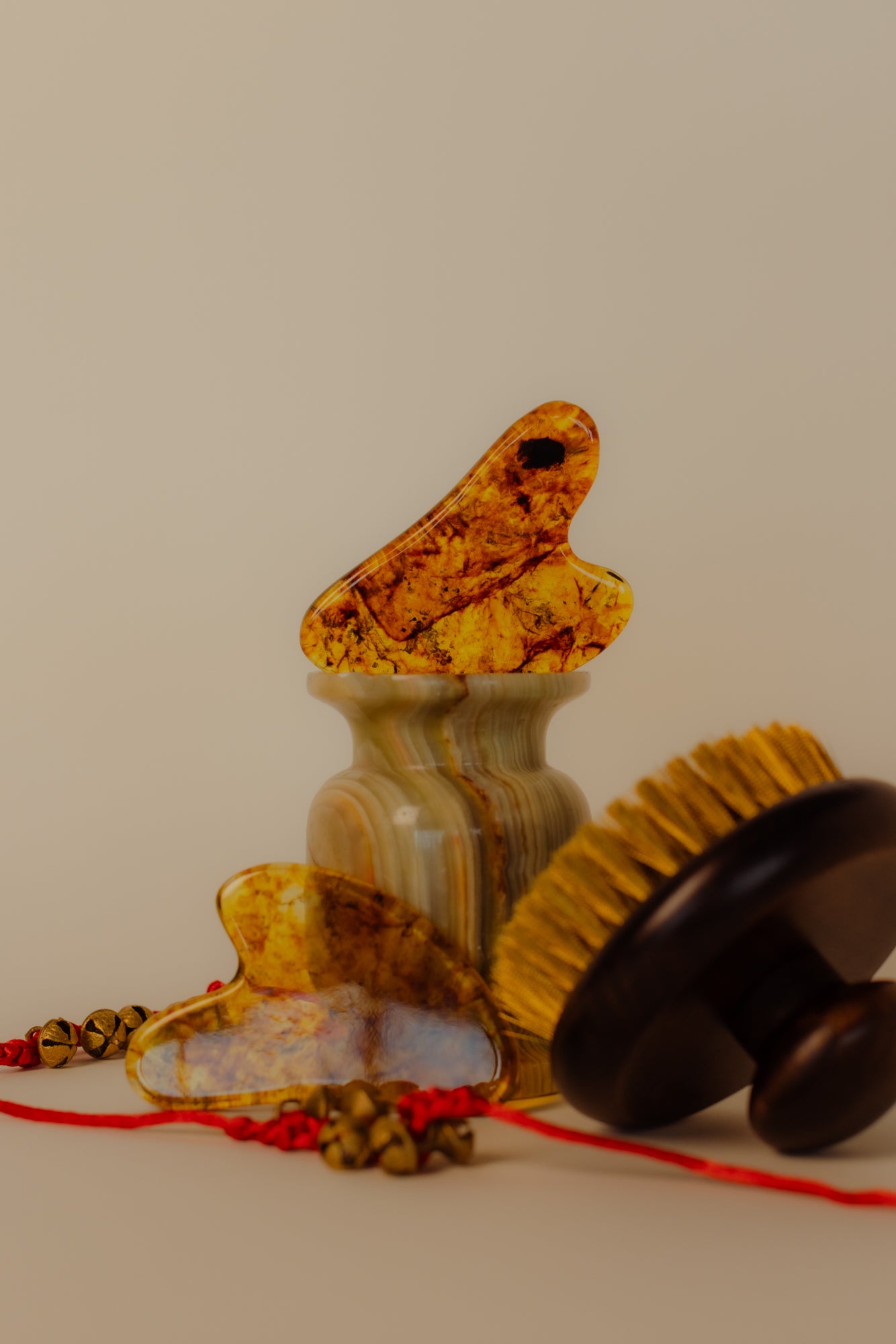
Möxche tools aren't a cure. They're not a treatment. They're a daily practice of listening — to skin, to fluid, to fascia, to the rhythms the body holds.
When you brush in the morning, you're not just exfoliating. You're checking in. When you gua sha at night, you're not just sculpting. You're noticing what's tense, where there's holding, what the day did to your face.
Ritual is paying attention. And the body, when it's paid attention to, will tell you what it needs.
Because true safety, love and healing aren't found outside of you. They've always been within you.
— Jess, founder & integrative health practitioner
Common questions
What is lymphatic drainage?
Lymphatic drainage is the movement of interstitial fluid through the lymphatic vessels back into the bloodstream. Unlike blood circulation, it has no central pump and depends on movement, breath, and external pressure.
How long does it take?
Three minutes is the dose. Five minutes is the ceiling. More is not better.
How often should I practice?
Daily is the rhythm we recommend. The body responds to consistency more than intensity.
Tools for this practice